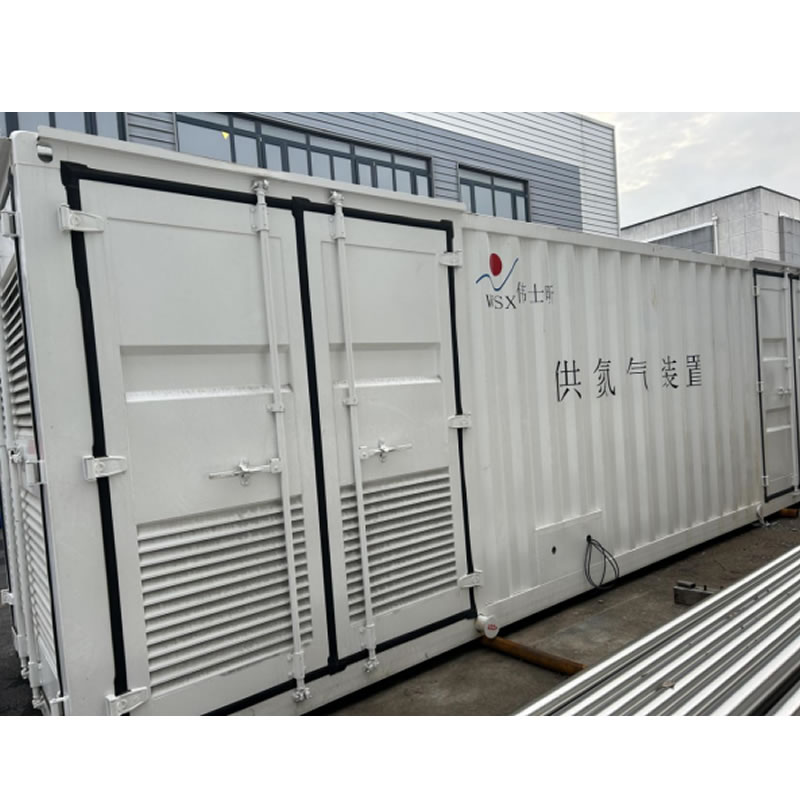
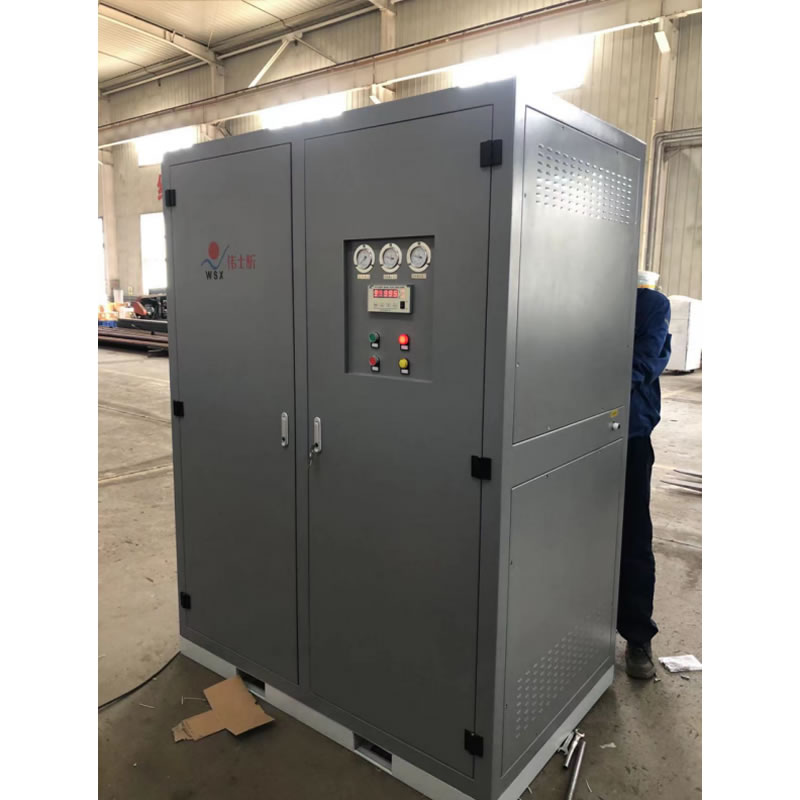
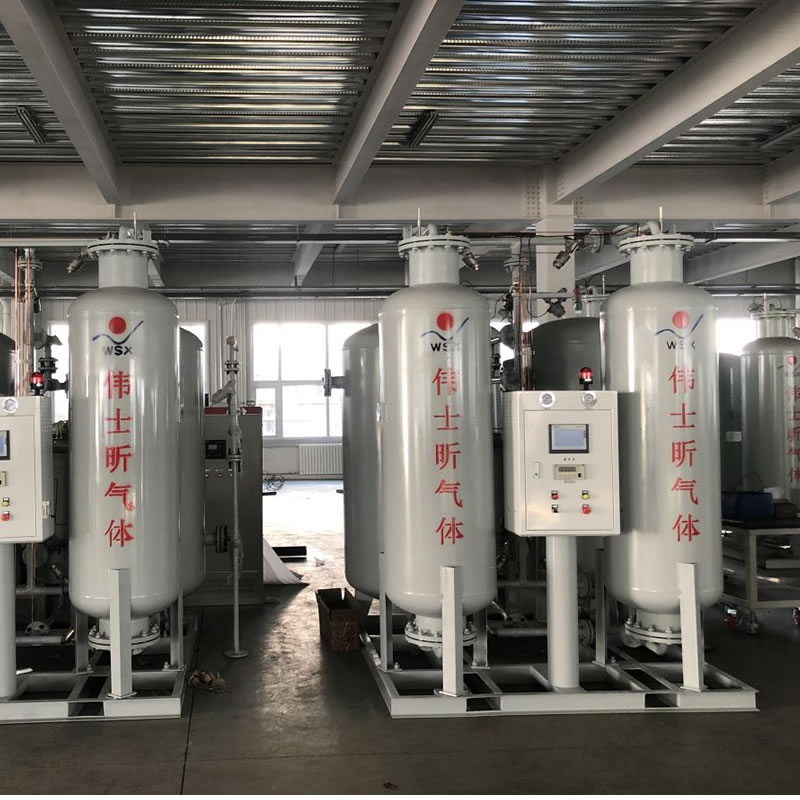
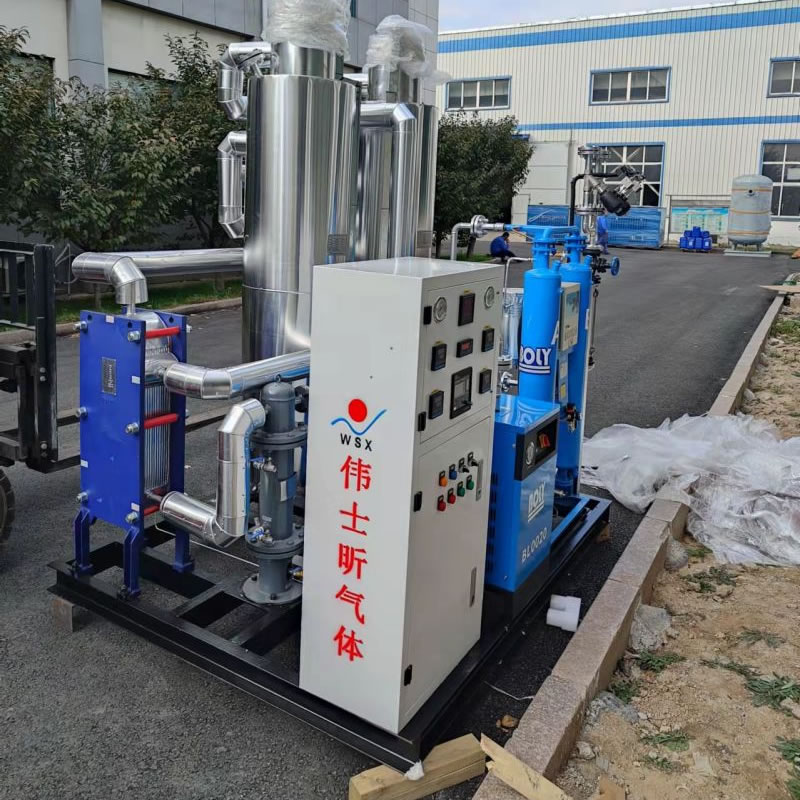
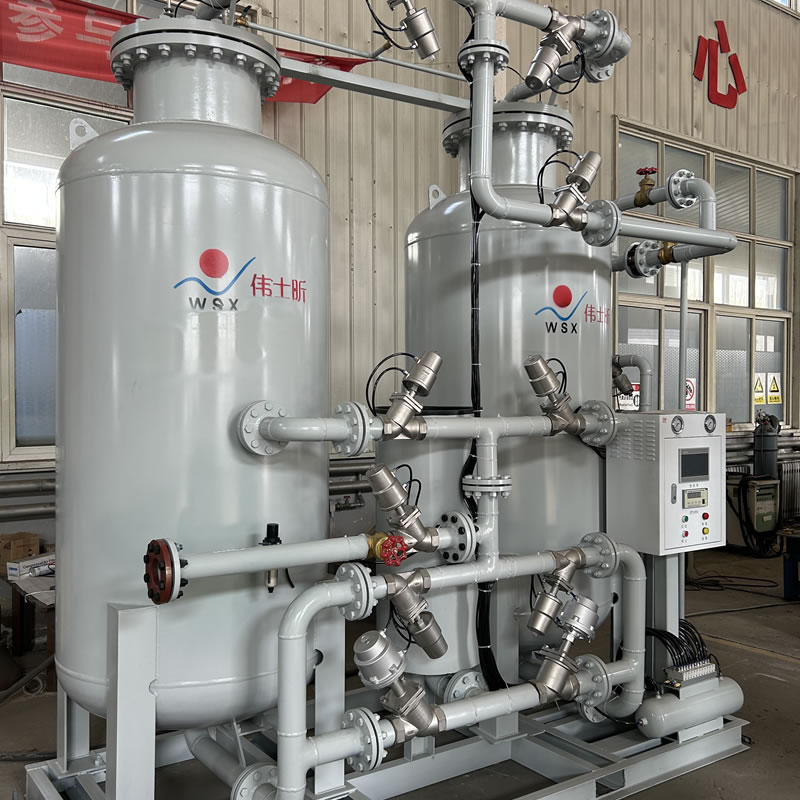
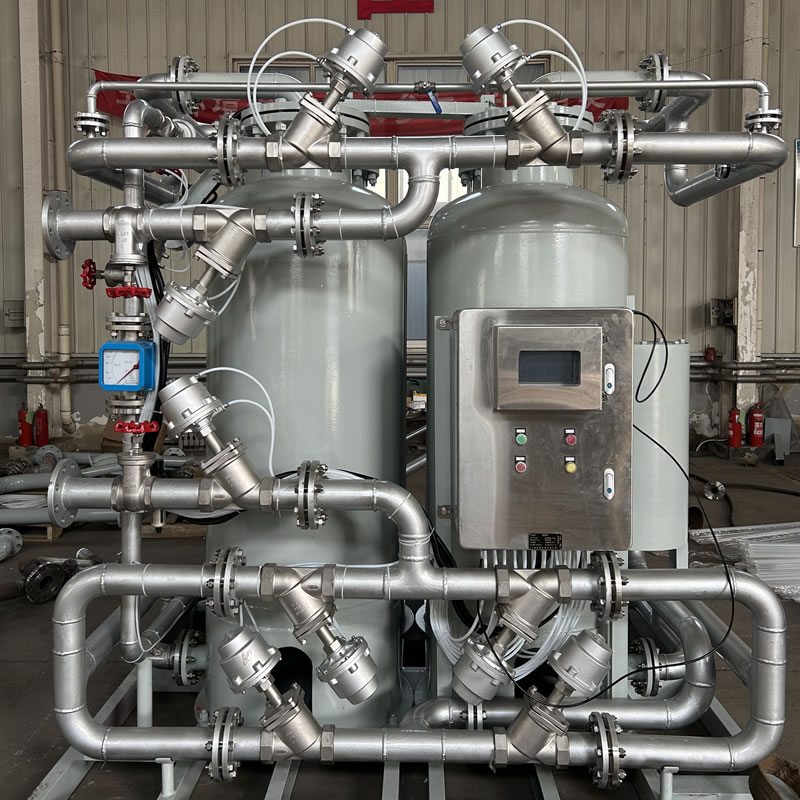
10 To 3000Nm3 Nitrogen Making
Voltage: 220V-450V,Plant Skid Mounted
Weight: based on equipment model,Machine 99.9% PLC N2,High Productivity,After-sales Service
Provided: Engineers provide 24-hour online service
The membrane module utilizes asymmetric hollow fiber membrane technology to separate and enrich nitrogen from compressed air. The air contains 78% nitrogen, 21% oxygen, 0.9% argon, and 0.1% other components. The membrane module produces qualified nitrogen by utilizing the principle of selective permeation. Various gas components dissolve and diffuse in the membrane, forming their own unique permeation rates. Oxygen is a fast gas, which quickly dissolves and permeates through the membrane wall, while nitrogen still flows along the inner cavity of the fiber filaments, forming a nitrogen-enriched gas stream. The oxygen-enriched gas stream or permeate gas permeates out of the membrane at atmospheric pressure and is vented. The driving force for separation is the partial pressure difference formed between the inner and outer cavities of the membrane by the various gas components.
| Nitrogen production capacity: | 10-3000 Nm³/h | |
| Nitrogen purity: | 95%-99.9% | |
| Nitrogen pressure: | 0.1-1.2 MPa | |
| Nitrogen dew point: | ≤-50℃ (under special circumstances, the nitrogen dew point can be selected to be below -60℃ | |
Process Flow:
Compressed air is dried by a refrigerated dryer or an adsorption dryer, and then purified through a filter. The purified air is heated to a set temperature by an electric heater and finally enters the hollow fiber bundles of a membrane separator. Under pressure, water vapor and oxygen permeate quickly through the membrane wall, while nitrogen permeates slowly and is retained. Under the action of the purity control system, unqualified nitrogen is vented, and qualified nitrogen is used for production.
The membrane nitrogen generator comprises a hollow fiber membrane module, an air filtration device, an air heating system, a system protection device, an online flow purity detection system, and control and electrical devices. The functions of each device are described below.
1. Hollow fiber membrane group: Utilizing asymmetric hollow fiber membrane technology to separate and enrich nitrogen from compressed air.
2. Air filtration device: It removes all oil components from the compressed air, achieving an oil content of 0ppm, and eliminates solid and liquid particles larger than 0.01μm.
3. Air heating system: The membrane module needs to operate at a certain temperature to achieve an appropriate gas production rate. Therefore, an air electric heater capable of automatic temperature control is installed in the inlet pipeline. The temperature control is detected by a thermal resistor, and the temperature control output is automatically adjusted according to PID.
4. System protection device: This device primarily serves to protect the membrane module. For instance, it prevents damage to the membrane module due to high temperatures.
5. Purity and flow rate online detection system: The nitrogen analyzer detects the oxygen content in nitrogen online, while the flowmeter measures the nitrogen flow rate online.
The membrane module is equipped with thousands of membrane fibers, whose ends are cast into tube blocks, or end caps, using epoxy resin. Cutting off the end caps exposes the inner pores of the fibers, allowing gas to flow from one end to the other. Then, this bundle of membrane fibers is placed into a suitable sheath, which protects the fibers while allowing gas to flow smoothly from the inlet to the outlet.
In the membrane separator, compressed air flows along the inner cavity of the hollow fibers. "Fast gases" such as oxygen, carbon oxides, water vapor, and a small amount of slow gases permeate through the membrane wall to the outside of the fibers. They are enriched at a pressure equivalent to atmospheric pressure outside the fibers and are discharged to a safe place as permeate gas or waste gas. Most slow gases and a small amount of fast gases continue to flow along the tube side, reaching the other end of the membrane module and being utilized as product nitrogen gas.

 EN
EN  AR
AR NL
NL FR
FR HI
HI KO
KO PT
PT RU
RU ES
ES TL
TL ID
ID VI
VI TH
TH TR
TR MS
MS SW
SW UR
UR BN
BN HA
HA KM
KM LO
LO PA
PA YO
YO MY
MY SI
SI AM
AM